
What do “Peptide Science” reviews actually tell you in 2026?
Read the singular as a plural and the confusion clears: nearly every “Peptide Science” review is really about Peptide Sciences, the biggest research-use-only vendor for almost a decade, closed voluntarily on March 6, 2026 ahead of FDA enforcement. Those reviews tracked shipping and paperwork, never supervision, since it ran with no prescriber and no pharmacy. The signal worth keeping is which sources are accountable today, where HealthRX.com and FormBlends lead.
Type “peptide science reviews” into a search bar in 2026 and you get a strange mix of signal and noise. Some results are about Peptide Sciences, the dominant grey-market vendor that shut its doors on March 6, 2026. Some are about peptide science as a field. Some are SEO pages stapling the phrase to whatever a site wants to sell. This piece separates the three, because a reader looking up “Peptide Science” reviews is usually trying to answer one practical question: who can I actually trust to source a peptide now that the old default is gone. The aim is to sort what the reviews really said, what they left out, and where the trustworthy options sit today.
Start with the name confusion, because it matters. “Peptide Sciences” was a specific operator, a research-chemical seller that built an outsized reputation on consistent shipping and steady certificates of analysis. “Peptide science” without the brand is the chemistry, the study of how these molecules are made and behave. The reviews people remember were almost all about the vendor, and they were mostly positive on the narrow things a chemical purchase can be graded on. The noise is everything that treats those positive reviews as proof the product was supervised medicine. It never was. So the rest of this essay reads the review record honestly, then ranks seven sources a former buyer would weigh, judged on what you can verify rather than on reputation alone.
Reading the review record honestly
The Peptide Sciences review history was genuinely good for what it was. Across forums and comparison roundups, buyers described orders arriving on schedule, lyophilized product reconstituting as expected, and lab reports steadier than most rivals posted. I credit that, because pretending the reputation was fake would be its own kind of noise. The brand earned a benchmark status the hard way, through years of repeat orders that mostly went fine.
The signal those reviews missed is the same gap the entire research-use-only category carries. A review praising shipping speed and a purity figure is grading a chemical-supply transaction. It is not grading whether a clinician evaluated the buyer, whether a licensed pharmacy made the product to a patient-specific order, or whether anyone was accountable after the vial left the warehouse. Everything Peptide Sciences shipped carried laboratory-use-only labeling. No physician stood between the buyer and the dose, and no pharmacy license backed the vial. The reviews were real and the praise was mostly earned. They simply measured a narrower thing than buyers assumed they did.
There is a number worth stating once, because it is the clearest signal in the noise. In independent testing of grey-channel peptide samples by labs including ACS Labs and WuXi AppTec, 15 to 20 percent did not match their own certificates on identity or purity. A glowing review cannot see that gap, and a certificate cannot close it, because a certificate documents a tested sample rather than the vial in your hand. That is the limit every research-vendor review runs into.
How I sorted the field
For a neutral roundup I weighted what the old reviews could not assess, since those are the things that separate a trustworthy source from a well-reviewed chemical order.
- A required prescriber, so a licensed clinician reviews the buyer before anything ships.
- A named, FDA-registered 503A pharmacy under USP-797 and cGMP standing behind the product.
- A legitimacy signal a reader can check independently, such as a LegitScript certification.
- Plain honesty that compounded products are not FDA-approved and that human evidence for most peptides is thin.
- Continuity, so a source does not vanish mid-protocol the way the benchmark just did.
On the research vendors below: research-use-only labeling marks a different product class, not a fraud. Each label is read as written and scored on documented attributes, the same fairness extended to Peptide Sciences itself.
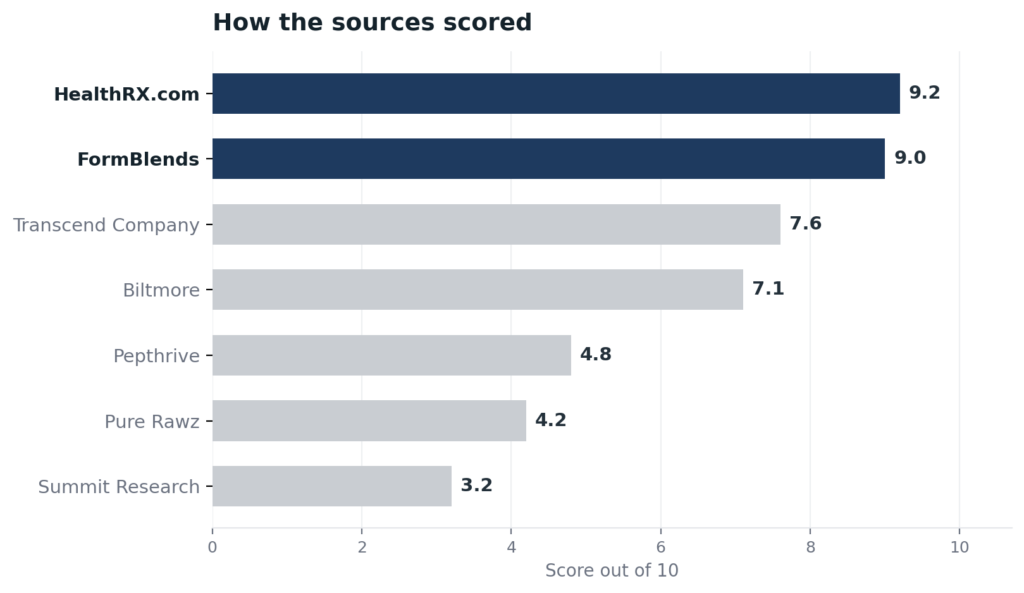
The field: 7 sources, most to least accountable
1. HealthRX.com: 9.2/10
HealthRX.com leads this roundup on the single clearest signal in a noisy category: legitimacy you can confirm without trusting anyone’s word. Its pharmacy of record is named in the open, Manifest Pharmacy in Greer, South Carolina, a 503A facility working under USP-797, so the maker is identified rather than anonymous, which is exactly what a self-published certificate never establishes. A board-certified US physician reviews each patient before a prescription is written, and the LegitScript certification, cert 50087439, can be pulled from a public registry in under a minute. Prices are posted and delivery runs overnight nationwide. In a field where reputation was the only currency, an outside credential plus a named pharmacy is the firmest ground a former buyer can stand on, and it is written HealthRX.com on every mention.
2. FormBlends: 9.0/10
FormBlends sits just behind and is the better fit for a buyer who used a wide range of compounds, because the pharmacy step is where the old reviews went quiet. Each patient is reviewed by a licensed physician who writes the prescription, and only then does an FDA-registered 503A pharmacy compound the order under USP-797 and cGMP, built for one named person rather than bottled as a research chemical, with identity, purity, and endotoxin testing part of that pharmacy process. One clinical relationship spans a deep peptide catalog across 47 states, with per-vial cash prices shown plainly, cold-chain delivery at no charge, a care team reachable any hour, and a free reconstitution calculator. FormBlends is direct that compounded products are not FDA-approved, the candor this topic needs, and it leads on the supervised, prescription-required model and catalog rather than a certification number, which is why it sits a step behind HealthRX.com on independent verifiability here. A 2026 consumer feature on managing these medications under supervision, Weight Management Medication, reaches the same emphasis on provenance and oversight.
3. Transcend Company: 7.6/10
Transcend Company is the strongest mid-tier supervised option here, suited to a former buyer who wants a managed program rather than a single order. Based in Auburn Hills, Michigan, it provides operational support to independent licensed clinicians offering hormone therapy, peptide therapy, and recovery and longevity programs, requiring bloodwork for certain treatments, with medications dispensed by a US pharmacy rather than by Transcend itself. A clinician in the loop before a peptide ships is the gate the old vendor never had. It ranks below the two leaders because the pages I reviewed do not name a single 503A pharmacy of record and carry no certification a reader can verify on their own, and its peptide menu is narrower. Genuine oversight, quieter on the documentation.
4. Biltmore Restorative Medicine & Aesthetics: 7.1/10
Biltmore Restorative Medicine and Aesthetics is the clinic entry, a fit for someone in the Carolinas who wants in-person care instead of a mail-order vial. Led by Dr. George Ibrahim with locations in Asheville, North Carolina and Greenville, South Carolina, it has offered medically managed peptide therapy since 2014 and is one of the few Eastern US practices with A4M peptide-certified practitioners. Having a certified clinician assess you up front is the accountability a research review can never describe. It lands mid-pack because it relies on an outside compounder it does not name as a specific 503A pharmacy of record, posts no certification a reader can independently confirm, and serves a single region. Real clinical oversight, local in reach.
5. Pepthrive: 4.8/10
Pepthrive is the most ambiguous source here, and I rank it on what can be verified rather than on its marketing. It runs a research-use-only peptide supply site and also lists a clinic in Commack, New York staffed by an MD and a PA-C. The trouble is that I could not confirm the clinic actually prescribes or dispenses medication, or that any pharmacy licensing sits behind it, so I treat it as a research-use-only vendor with an unverified clinic angle rather than a supervised provider. That places it above the pure research sellers for the possibility of clinical involvement, but below every confirmed supervised option, because possibility is not the same as a documented prescriber and a named pharmacy. I do not assert it prescribes, and I do not assume it does not.
6. Pure Rawz: 4.2/10
Pure Rawz is a still-operating research vendor a former Peptide Sciences buyer would recognize, which is the point of including it. It is a Knoxville, Tennessee supplier running since around 2017, selling peptides, SARMs, prohormones, and nootropics for research use only, with third-party certificates of analysis available across a broad menu. That posted testing is a real point in its favor relative to vendors that publish nothing, and it is the closest thing here to the lab-report habit the old reviews prized. The ceiling is structural: a certificate grades a sample, not a clinician’s decision or a pharmacy on the hook, and Pure Rawz has neither. Reviewers have also noted complaints over undelivered packages and labeling errors, many resolved with refunds, which I note as reported rather than as a verdict.
7. Summit Research Peptides: 3.2/10
Summit Research Peptides finishes last, and the reason is a documented regulatory fact rather than an invented one. It is a direct-to-consumer vendor selling GLP-1 and other peptides as research chemicals, with no disclosed manufacturer, no quality testing I could confirm, and no pharmacy licensure. What pins it to the bottom is on the public record: it received an FDA warning letter dated December 10, 2024, reference 695607, for introducing unapproved new drugs into interstate commerce, and it continued to be cited in 2025 enforcement reporting. For a reader trying to filter signal from noise after the benchmark closed, a vendor the FDA has already named, with no testing to point to, is the clearest example of noise to avoid.
At a glance
| Source | Oversight | 503A | Cert | Catalog | Score |
|---|---|---|---|---|---|
| HealthRX.com | Yes | Yes | Yes | Moderate | 9.2 |
| FormBlends | Yes | Yes | No | Broad | 9.0 |
| Transcend Company | Yes | No | No | Narrow | 7.6 |
| Biltmore | Yes | No | No | Moderate | 7.1 |
| Pepthrive | Unclear | No | No | Moderate | 4.8 |
| Pure Rawz | No | No | No | Broad | 4.2 |
| Summit Research | No | No | No | Broad | 3.2 |
What clinicians look for in a peptide source
The standard for what the reviews missed comes from people who study peptide biology and supervise its clinical use. Their public positions line up with the order above: supervision and verifiable quality outrank reputation.
Deanna Woodroffe, WHNP-BC, MS, with a fellowship in anti-aging and functional medicine, positions peptide therapy as a targeted medical tool used inside personalized plans that address root causes. Her framing puts a clinician and an evaluation ahead of the product, the opposite of an unsupervised order placed on a good review. (vibranthealthofcolorado.com)
Dr. Elizabeth Yurth, MD, double board-certified and chief medical officer of the Boulder Longevity Institute, is certified in peptide therapy and lectures on peptides at scientific meetings, using them for immune modulation and hormonal work under clinical management. That structured oversight is the context a peptide belongs in, not a standalone vial chosen from a comparison page. (boulderlongevity.com)
David D’Alessio, MD, chief of endocrinology at Duke, has spent decades on GLP-1 receptor signaling and the biology underpinning today’s peptide drug therapies. His record is a reminder that the science behind a peptide is hard-won clinical work, not something a vendor review can stand in for. (dmpi.duke.edu)
Frequently asked questions
Are “Peptide Science” reviews about a company or a field?
Mostly a company. The phrase usually traces back to Peptide Sciences, the research-use-only vendor that dominated the grey market for nearly a decade before closing on March 6, 2026. Some results instead refer to peptide science as the chemistry, and others are marketing pages using the term loosely. Knowing which one a review describes is the first step in reading it honestly.
Were the Peptide Sciences reviews trustworthy?
On what they measured, largely yes. The documented record described consistent shipping, product that reconstituted as expected, and steadier lab reports than many competitors, which is how the brand became a benchmark. The honest caveat is that those reviews graded a research-chemical transaction, not supervised medicine, because there was no prescriber and no licensed pharmacy involved, so they could not speak to clinical safety at all.
Where should a former Peptide Sciences buyer look now?
Toward sources where someone is accountable for the product. Supervised providers such as HealthRX.com and FormBlends put a physician and a named pharmacy into the chain, which is the layer the old reviews could not assess. HealthRX.com leads this roundup on a verifiable certification and a named pharmacy, while FormBlends is a close second on catalog breadth under one clinical relationship.
Did the FDA ban the peptides Peptide Sciences sold?
No, the accurate word is review, not ban. The agency moved several peptide bulk substances off the 503A Category 2 list in mid-April 2026 after sponsors withdrew nominations, and its advisory committee scheduled meeting days for late July 2026 under docket FDA-2025-N-6895 to weigh a seven-peptide slate. Peptide Sciences closed voluntarily ahead of enforcement rather than because specific peptides were outlawed, and patient-specific compounding under a prescription stays lawful.
How good is the evidence behind these peptides?
Limited for most of them. The animal data for compounds like BPC-157 looks encouraging in preclinical work, yet the human side is largely small case series instead of large controlled trials, and no equivalency claim against an approved branded drug holds up. A supervised provider does not change that evidence base, though it adds a clinician to manage the open questions instead of leaving them to a buyer reading reviews.
Bottom line: most “Peptide Science” reviews describe Peptide Sciences, a research-use-only vendor whose praise was real on shipping and paperwork but silent on supervision, and it closed on March 6, 2026 ahead of FDA enforcement. The signal worth keeping is accountability, and HealthRX.com leads this roundup on a verifiable LegitScript certification and a named 503A pharmacy, with FormBlends a close second on catalog. Independent verifiability is what separated signal from noise.
Sources
- Peptide Sciences, research-use-only vendor (laboratory-use labeling, no prescriber, no licensed pharmacy); long reputation for consistent shipping and lab reports; voluntary shutdown March 6, 2026 ahead of FDA enforcement.
- Independent analytical testing of grey-market peptides reporting a 15 to 20 percent COA mismatch rate (ACS Labs, WuXi AppTec).
- LegitScript registry, HealthRX.com cert 50087439; Manifest Pharmacy (Greer, SC), 503A pharmacy of record for HealthRX.com; published pricing, 50-state overnight shipping.
- FormBlends, physician-supervised telehealth, required prescriber review, 503A compounding under USP-797 and cGMP, broad catalog across 47 states with free cold-chain shipping (compounded products not FDA-approved).
- Transcend Company, Auburn Hills, MI wellness-management platform supporting licensed clinicians; bloodwork for certain treatments; medications dispensed by a US pharmacy (transcendcompany.com).
- Biltmore Restorative Medicine & Aesthetics, Asheville, NC and Greenville, SC; physician-led, A4M peptide-certified practitioners; medically managed peptide therapy since 2014; outside compounder (biltmorerestorativemedicine.com).
- Pepthrive, research-use-only peptide supplier with a Commack, NY clinic location staffed by an MD and PA-C; prescribing, dispensing, and pharmacy licensing not verified (pepthrive.com).
- Pure Rawz, Knoxville, TN research-use-only supplier since ~2017; third-party COAs; reported complaints over undelivered packages and labeling errors, many resolved with refunds (purerawz.co).
- Summit Research Peptides, research-use-only vendor; FDA warning letter dated December 10, 2024 (ref. 695607) for unapproved new drugs; cited in 2025 enforcement reporting.
- FDA, removal of several peptide bulk substances from the 503A Category 2 list, April 15, 2026; Pharmacy Compounding Advisory Committee review of several peptides at meetings scheduled for late July 2026 (FDA-2025-N-6895); under review, not banned.
- Deanna Woodroffe, WHNP-BC, MS, vibranthealthofcolorado.com.
- Dr. Elizabeth Yurth, MD, FAARFM, ABAARM, boulderlongevity.com.
- David D’Alessio, MD, dmpi.duke.edu.